







Your small bedroom doesn’t need “more space.” It needs fewer obstacles between you and the way you actually live – getting dressed without bumping into a chair, charging your phone without a cord jungle, and waking up in a room that feels calm instead of cramped.
This is the real secret of how to decorate a small bedroom: stop treating it like a miniature version of a bigger room and start treating it like a high-performing one. When every inch earns its keep, small can feel intentionally designed – not temporary.
Start with the room’s job (not its style)
Before you choose a color or buy a new nightstand, decide what your bedroom must do every day. For some people, it’s strictly sleep and getting ready. For others, it’s also a reading spot, a yoga corner, or a work-from-home setup.
Small bedrooms punish “maybe” furniture. If you’re not using a bench, a vanity, or an extra chair weekly, it becomes a space tax. The best-looking small rooms are edited rooms.
A quick rule that helps: every item should either improve sleep, improve storage, or improve the feeling of the room. Ideally, it does two.
Layout first: clear paths beat perfect symmetry
In a tight room, flow matters more than traditional design rules. You can make beautiful choices, but if you’re squeezing sideways between the bed and dresser, the room will always feel smaller.
Start by protecting a comfortable walkway – roughly 24 inches is a good target where possible, especially on the side you use most. If you can only have one “good” side of the bed, commit to it. It’s better to have one easy path than two frustrating ones.
If your bed is currently centered but the room feels tight, try shifting it. Centering looks nice in photos, but in real life, it can steal usable floor space from where you need it most (like the closet side or the entry).
Choose the right-size bed frame (and be honest)
A tall footboard, chunky sleigh bed, or oversized headboard can visually dominate a small room. If you want the bed to feel lighter, look for a simple frame, slim rails, and legs that show some floor.
And yes, mattress size is a real trade-off. If your room is truly small, a queen can work, but it may force you into micro nightstands and tight clearances. A full-size bed often looks more proportional and can feel more luxurious because the room becomes easier to use. The “right” answer depends on whether you value sleeping sprawl or daily comfort getting around.
Color strategy: keep it airy, then add contrast on purpose
Light colors aren’t mandatory, but they’re forgiving. Soft whites, warm creams, pale grays, and gentle greiges help walls recede, which makes the room feel more open.
If you love deeper color, use it intentionally rather than everywhere. A dark accent wall behind the bed can add depth and make the room feel designed, especially if the other walls stay lighter. The key is balance: deep color plus good lighting equals cozy; deep color plus poor lighting equals cave.
A simple approach that works in most small bedrooms: keep the ceiling and trim lighter than the walls. That subtle shift lifts the room visually.
Pattern in a small room: scale matters
Tiny prints can make a small bedroom feel busy. One larger-scale pattern (like a bold pillow, a substantial rug pattern, or big stripes) often reads cleaner than many small competing patterns.
Lighting: layer it so the room doesn’t rely on one harsh source
A single overhead fixture can make a small bedroom feel flat, especially if it’s a cool-toned bulb. Layered lighting adds softness and dimension – which reads as “more space.”
Use a warm white bulb (around 2700K) for a bedroom feel, then combine at least two of these: bedside lamps, a wall sconce, a floor lamp in a corner, or LED strips tucked behind a headboard or under a floating shelf.
If your nightstands are tiny or nonexistent, wall-mounted sconces (hardwired or plug-in) free up surface area and look custom without requiring a big footprint.
Storage that doesn’t look like storage
Small bedrooms fail when clutter is visible. The goal isn’t to own nothing – it’s to hide the everyday stuff so the room can feel restful.
Start with the easiest win: under-bed storage. If you’re using bins, choose matching ones and keep categories clear (extra linens, off-season clothing, shoes). If you’re buying a new bed, consider a storage bed with drawers, but measure carefully: drawers need clearance to open, and in a narrow room they can be annoying.
Next, look vertical. Tall dressers, wall shelves, and over-the-door organizers use space you already have without shrinking the floor.
Nightstand alternatives that save inches
If a traditional nightstand crowds the room, swap it for a narrow pedestal, a small wall shelf, or a slim table. You only need space for the essentials: a lamp or sconce switch, a glass of water, and your phone.
A headboard with a built-in ledge can also replace a nightstand entirely, which is a game-changer in ultra-tight rooms.
Closet strategy: make it do more with less
A messy closet spills into the bedroom fast. Add a second hanging rod, use matching slim hangers, and store rarely used items higher up. If you have open shelving, use baskets or bins to keep the visual field calm.
If you’re planning bigger changes, a simple closet system (even a basic rail-and-shelf setup) can outperform a crowded dresser and free up floor space.
Mirrors and glass: use them like design tools, not decor filler
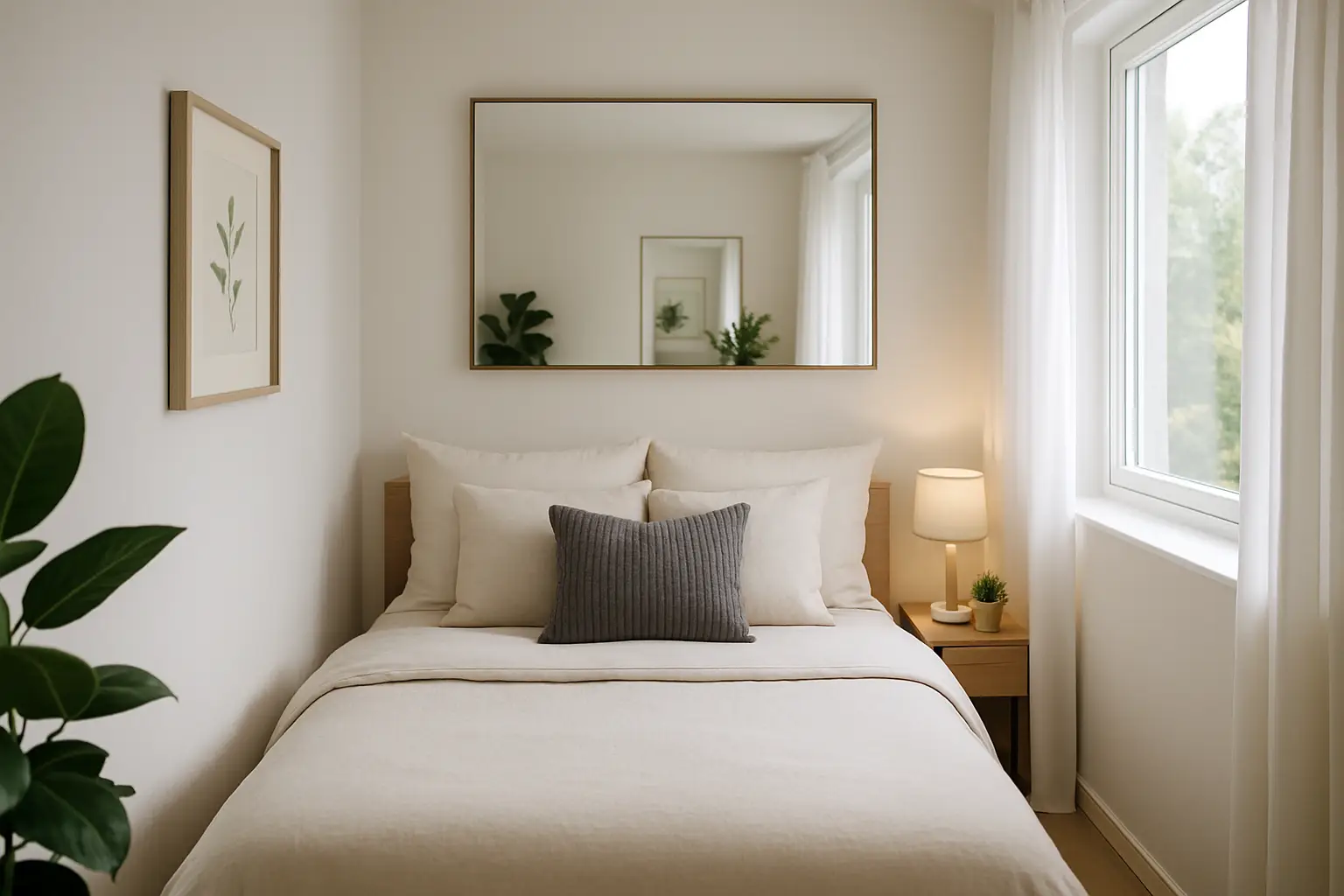
A mirror can double the light and visually expand a small bedroom, but placement matters. Put it where it reflects something worth reflecting: a window, a lamp glow, or a clean wall.
If a full-length mirror leans and constantly shifts, mount it. That single move makes the room feel more intentional and less temporary.
Glass or acrylic pieces (like a clear side table) can also feel lighter than solid wood. The trade-off is practicality: fingerprints show, and not everyone wants a delicate look. Use these materials sparingly for the biggest impact.
Textiles: go big enough to feel tailored
In small rooms, undersized textiles make everything look accidental.
A too-small rug is a common culprit. Ideally, the rug should extend beyond the sides of the bed so your feet land on something soft when you get up. If budget is tight, you can place a larger rug partially under the bed so it still reads generous.
For bedding, keep the palette controlled and add texture for depth – think a quilted coverlet, a knit throw, or linen pillows. Texture gives you that “designed” feeling without adding clutter.
Window treatments matter more than people think. Hanging curtains higher (closer to the ceiling) can make the room feel taller. If privacy is a concern, pair curtains with a simple shade so you can control light while keeping the look soft.
Style with intention: fewer objects, stronger choices
A small bedroom can handle personality – it just needs cleaner editing.
Instead of many small frames scattered around, try one larger piece of art above the bed or a tight grouping that reads as a single statement. Keep the color story connected to your bedding so it doesn’t feel like visual noise.
Plants work well in small rooms because they add life without taking much space. If you’re short on surfaces, consider a hanging planter by the window or a small plant on a dresser.
And if you love personal mementos, display them like a collection, not like leftovers. A tray on a dresser or a single shelf dedicated to favorite objects keeps the room curated.
Smart upgrades for small bedrooms (that feel modern)
If you want a bedroom that feels current, a few small tech-forward moves can reduce clutter and boost comfort.
A smart bulb or smart dimmer lets you soften lighting instantly without swapping fixtures. A compact charging station (or a wall outlet with USB ports) cleans up cables. If you’re planning a refresh and want to test layouts before you move furniture, simple 3D room planning tools can help you see whether a dresser truly fits without blocking a drawer or walkway.
If you like designing with a bit of structure, you can find more planning-first room ideas at Home Design United.
Common small-bedroom mistakes (and what to do instead)
Most “small bedroom problems” come from a few predictable patterns.
One is choosing furniture based on looks alone. A beautiful dresser that prevents you from opening the closet door will never feel like a win. Always measure clearances, not just the furniture width.
Another is over-decorating vertical surfaces. Gallery walls, floating shelves, and hooks are great – until every wall becomes a storage zone. Leave at least one wall quiet so your eyes can rest.
The last is ignoring comfort. Minimalism isn’t the goal if it makes the room feel cold. The best small bedrooms have softness somewhere: a warm light, a textured blanket, a rug that feels good barefoot.
A simple way to decide what to change first
If you’re staring at your room and don’t know where to begin, start with the one change that will make daily life easier. That might be swapping a bulky nightstand for a slim shelf, moving the bed to create a better path, or adding a second light source so the room feels calmer at night.
When your small bedroom supports your routines, the decorating choices get easier – because every decision has a purpose. Make the room feel good to live in, and it will automatically start looking better, too.