








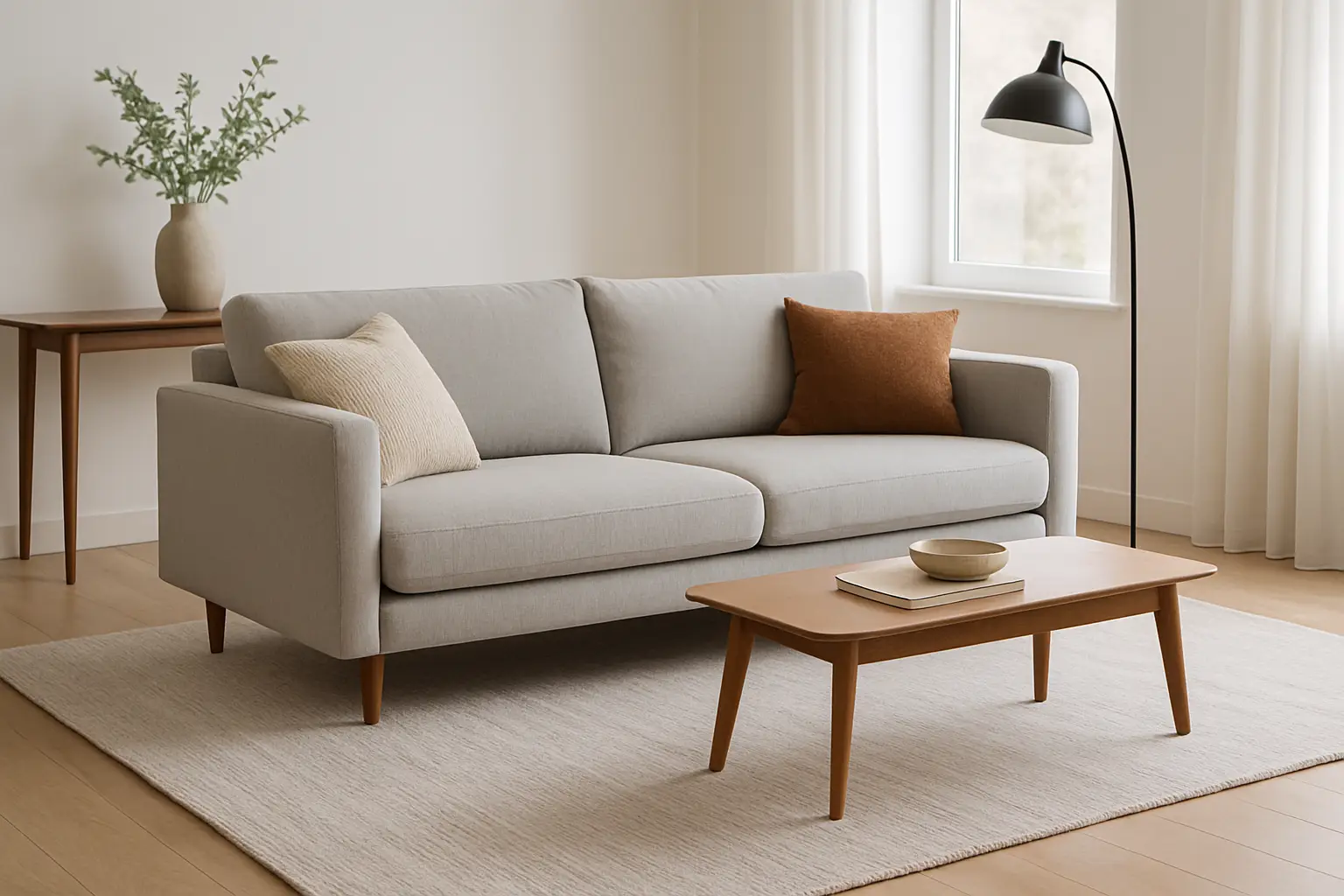
You can buy a gorgeous rug and still end up with a living room that feels slightly “off.” Most of the time, it’s not the color or the pattern – it’s the scale. A rug that’s too small makes furniture look like it’s floating. A rug that’s too big can swallow walkways and make the room feel crowded. The good news: once you know a few layout rules, rug sizing becomes one of the fastest ways to make a living room feel intentional.
Area rug size guide living room: start with the room, not the rug
The easiest way to get the right size is to decide what you want the rug to do. In most living rooms, the rug’s job is to visually “anchor” the seating area so the sofa, chairs, and coffee table read as one zone.
Before you shop, grab a tape measure and note three things: the room’s width and length, the approximate footprint of your seating area (sofa length plus chair depth), and where people actually walk through the space. In open-concept rooms, the rug is often the line that separates “living” from “dining” without building a wall.
A helpful starting rule is to leave a border of visible floor between the rug and the walls. In many rooms, 8-18 inches of floor border looks balanced. Smaller rooms often look best with less border (closer to 8-12 inches). Larger rooms can handle more. This border is why buying the biggest rug you can find isn’t always the answer – you still want the room to breathe.
The three layouts that determine your rug size
Instead of memorizing dozens of rug dimensions, choose the layout you want. Your layout determines your ideal size more than your sofa does.
1) All legs on (most polished)
With this approach, the rug is large enough that the front and back legs of the sofa and main chairs sit on it. It tends to look the most “designer” because every piece feels connected.
This layout works best when you have the space to maintain walkways, especially behind or beside seating. It’s also a great choice in open-concept living rooms where you want the seating zone to feel clearly defined.
2) Front legs on (most common and flexible)
Here, only the front legs of the sofa and chairs sit on the rug. You still get that anchored feeling, but you don’t need as much square footage.
If you’re working with a standard living room or you’re trying to keep costs in check, this is the sweet spot. It also makes furniture rearranging easier, since you’re not locked into one exact footprint.
3) Floating (best for tiny spaces, but risky)
A floating rug sits under the coffee table but doesn’t reach the furniture legs. It can work in very small rooms or with apartment-scale furniture, but it’s the layout most likely to look undersized.
If you choose this route, go bigger than you think and make sure the rug is still wide enough to extend beyond the coffee table on all sides. Otherwise, it can look like an afterthought.
Living room rug size cheat sheet (with real-world fit)
Most living rooms in the US end up in a handful of sizes. Think of these as practical “defaults” that you confirm with your measurements.
5×8: best for small seating areas
A 5×8 rug can work when you have a compact sofa (or loveseat), a small coffee table, and limited floor space. It’s most successful in the front-legs-on layout with smaller furniture, or in a studio where the seating zone is intentionally tight.
The trade-off: in an average-sized living room, 5×8 often reads too small unless your furniture is scaled down. If you’re on the fence between 5×8 and 8×10, the 8×10 usually wins.
8×10: the “most likely to work” size
An 8×10 is a go-to for many living rooms because it typically reaches the front legs of a standard sofa and chairs while still leaving a comfortable border of floor around the edges.
If your living room is a typical rectangular shape and your seating is arranged around a central coffee table, this size often delivers that anchored look without forcing you to push furniture against walls.
9×12: best for larger rooms and open concept
A 9×12 rug looks right in bigger living rooms, especially when you’re aiming for the all-legs-on layout. It’s also ideal when you have a sectional and want the rug to extend generously beyond the chaise or corner seat.
The trade-off is walkway planning. A 9×12 can feel amazing underfoot, but only if you still have clear paths through the room. If it blocks a door swing or tightens the route to a hallway, it will feel irritating fast.
10×14 (and larger): for “great room” scale
If you have a true great room, tall ceilings, or a long, wide seating zone, oversized rugs can be what finally makes the space feel proportional. They’re especially helpful when your sofa is long (90+ inches) and you have multiple accent chairs.
Just be sure you’re not covering floor vents you need access to or creating awkward transitions into adjacent zones.
Sectionals, L-shapes, and the chaise problem
Sectionals are where rug sizing gets tricky, because the chaise tempts you to size the rug to the longest side. Instead, size for the overall seating footprint.
If you want a clean, cohesive look, aim for a rug that extends at least 6-12 inches beyond the outer edges of the sectional on the “open” sides. In many homes, that pushes you toward an 8×10 or 9×12.
If your sectional is tight to the wall, the front-legs-on approach is often the most realistic: the rug tucks under the front edge of the sofa and runs far enough to hold the coffee table and the primary walking area. The goal is comfort and visual balance, not forcing every inch of furniture onto the rug.
Spacing rules that keep the room feeling intentional
Rug size isn’t just about length and width – it’s about the negative space around it.
Try to keep a consistent floor border along the rug’s visible edges. If one side has 3 inches of floor showing and another has 18, it can make the rug look crooked even when it’s perfectly straight.
Also consider how the rug relates to the coffee table. In most living rooms, the coffee table should sit fully on the rug, with enough rug showing around it that it doesn’t feel cramped. If your table is half-on, half-off, it often signals the rug is too small for the zone.
Common rug sizing mistakes (and easy fixes)
The most common mistake is choosing a rug based on what looks “safe” online. A slightly-too-small rug feels like a budget compromise even when it’s expensive.
Another frequent issue is ignoring furniture width. If your sofa is 84 inches long and your rug is only 60 inches wide, the sofa visually overwhelms the rug. A good target is for the rug to be at least as wide as the sofa, and ideally a bit wider.
Finally, watch for rugs that stop short of key seats. If your main chair is off the rug entirely, it can feel disconnected from the conversation area. Moving the chair slightly inward or sizing up often fixes the whole room.
A quick, low-stress way to choose the right size
If you want a near-foolproof method, map it first.
Use painter’s tape to outline potential rug sizes on the floor – 5×8, 8×10, 9×12. Then place your coffee table within the taped shape and check where the sofa and chair legs would land. Walk through the space like you normally do: from the doorway to the sofa, around the coffee table, toward any adjacent rooms.
You’re looking for two wins at the same time: the seating area feels connected, and your walkways still feel natural. If you’re using planning tools or experimenting with layout options, this kind of “test fit” is exactly the practical, decision-making approach we love at Home Design United.
Choosing between sizes when you’re stuck
If two sizes seem viable, decide based on what bothers you more: visual looseness or tighter walkways. A larger rug usually looks more elevated, but only if it doesn’t make the room harder to live in.
In family rooms where kids play on the floor, sizing up can be a comfort upgrade – more soft landing space, more room for board games, more cozy movie nights. In high-traffic rooms or narrow living rooms, a slightly smaller rug that preserves circulation can feel better day to day.
One more “it depends” factor: furniture you plan to replace soon. If you’re upgrading from a loveseat to a full sofa within a year, don’t buy a rug that only works for the smaller piece. Buy for the room you’re building toward.
If you want your living room to feel pulled together fast, choose the rug size that makes your seating area look like it belongs together, then let the pattern and color be the fun part – your feet will feel the difference every day.