







You know the moment: the kitchen pendants look amazing, but the sofa area feels like a cave. Or the living room lamp glow is cozy – until you sit down to eat and realize the dining table is in the shadows. Open concept layouts are supposed to feel easy, but lighting is where they often fall apart.
A strong lighting plan for open concept living is less about picking a “pretty fixture” and more about designing a system. You’re creating multiple moods for multiple activities in one connected space, without turning it into a runway of mismatched lights. The good news: once you understand layers, zones, and control, the decisions get a lot simpler – and your home feels instantly more intentional.
Start by mapping your real-life zones
Open concept lighting works best when you stop thinking “one room” and start thinking “three to five jobs happening near each other.” Most open plans include some combination of kitchen, dining, living, and an entry or hallway pass-through. The trick is to define invisible boundaries using light.
Stand in your space (or pull up your floor plan) and label what happens where. Cooking and cleanup need bright, accurate light. Dining needs flattering, focused light. Living areas need flexible, layered light for TV, conversation, reading, and relaxing. If you work from your dining table or do homework at the island, that changes the plan.
This zoning step also keeps you from over-lighting. In open layouts, people often add fixtures everywhere because the space feels big. But bright light in the wrong spot reads as glare, not “well lit.”
Think in layers, not fixtures
You’ll hear designers talk about layered lighting, and in open concept spaces it’s non-negotiable. You’re aiming for a mix of ambient (overall), task (work), and accent (depth) lighting so the space feels balanced from every angle.
Ambient lighting is your base layer. In an open plan, it’s usually recessed lights, a central fixture, or a combination. Task lighting is the “I need to see what I’m doing” layer – under-cabinet strips, pendants over an island, a focused light over a desk corner. Accent lighting is what makes the room feel finished: picture lights, a floor lamp that grazes a wall, toe-kick lighting, or a soft wash over shelves.
If you only do ambient, the space feels flat and a little commercial. If you only do pendants and lamps, the space gets patchy. Layering is how you get that comfortable, magazine-level glow that still functions on a Tuesday night.
Choose a consistent color temperature (and stick with it)
Nothing makes an open concept space feel “off” faster than mixed bulb colors. One area looks crisp and blue, another looks yellow, and your finishes never look the same from one zone to the next.
For most homes, 2700K to 3000K is the sweet spot. 2700K reads warmer and cozier (great for living areas). 3000K is still warm but a bit cleaner (great for kitchens). If your open plan flows from kitchen to living with no real divider, 3000K across the board is often the easiest way to keep continuity while still feeling inviting.
Also pay attention to CRI (color rendering). If you care about how your paint, wood tones, and fabrics actually look, aim for bulbs and fixtures rated 90+ CRI when possible. It’s a small upgrade that can make your whole space feel more high-end.
Plan the kitchen first, because it sets the tone
In many open layouts, the kitchen is the brightest zone – and it should be. The mistake is letting the kitchen brightness spill everywhere, making the living area feel harsh.
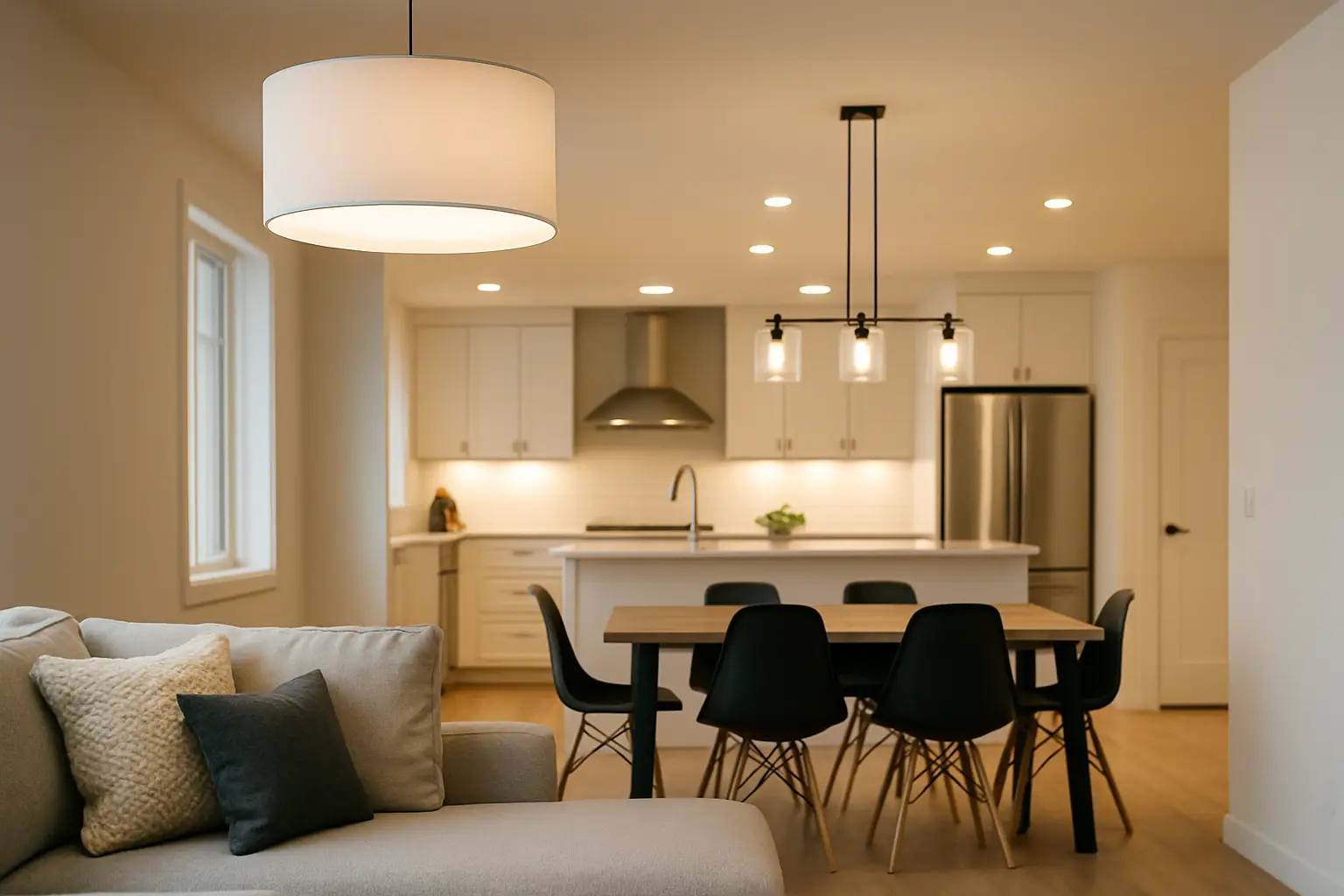
Start with task lighting where you prep and clean. Under-cabinet lighting is one of the highest-impact upgrades you can make, because it eliminates counter shadows that recessed lights often create. Then decide how you want to light the island: pendants give style and focus, while recessed lights keep the ceiling visually calmer. Either can work – it depends on your ceiling height, sightlines, and how much visual “jewelry” you want.
For recessed lighting, spacing and placement matter more than quantity. Lights centered in open floor space can feel like a grid of glare. A better approach is placing recessed lights to serve zones: over the sink line, over the range area, and around the perimeter where you need coverage.
If you love pendant lights, treat them like furniture scale. Too small and they look like an afterthought. Too large and they dominate the whole open plan. As a practical guideline, pendants over an island usually look best when they hang low enough to feel intentional but high enough to keep sightlines open. Dimmers help you make them work beyond meal prep.
Give the dining area its own identity
Dining is where open concept lighting can feel most awkward, because you want intimacy inside a big shared volume. The simplest fix is a dedicated dining fixture on its own switch, ideally on a dimmer.
A chandelier or linear pendant centered over the table creates an instant “room” without walls. If your table shifts position (common in flexible spaces), consider a fixture that visually spans the table length so you have some wiggle room.
Here’s the trade-off: a statement dining fixture can be stunning, but it also becomes a focal point from the living room and kitchen. If your open plan already has bold pendants, you may want the dining light to be quieter in shape and finish. If the rest of the lighting is minimal, the dining fixture can be the star.
Make the living area flexible, not bright
Living rooms inside open concepts shouldn’t compete with kitchen task lighting. They should feel adaptable: bright enough for reading and cleaning, soft enough for movie night.
This is where lamps do a lot of heavy lifting. A floor lamp near the sofa, a table lamp on a console, and a reading light by a chair create pockets of comfort. Layer in at least one form of indirect light (a lamp that bounces light off a wall, or a fixture that washes upward) so the ceiling doesn’t go dark when you dim the recessed lights.
If you rely only on ceiling lights in the living zone, you’ll end up with either a bright space that doesn’t relax, or a dim space that doesn’t function. Lamps give you the in-between settings that make open concept actually livable.
Put lights on the right switches, or the plan won’t work
The most beautiful fixtures won’t save you if everything is on one switch. Open concept spaces need scene control. That doesn’t have to mean a full smart-home overhaul, but it does mean thinking through how you move through the space.
At minimum, separate the kitchen ambient, kitchen task, dining fixture, and living ambient. If you can, separate the living lamps (or at least one outlet) so they can be controlled without crossing the room.
Dimmers are the secret weapon. They let you keep the same fixtures but change the feel completely. Bright for cooking, medium for hosting, low for winding down. If you’ve ever felt like your open plan is either “operating room” or “cave,” dimming and better circuiting are usually the fix.
Smart switches can take this further with scenes like “Morning,” “Dinner,” and “Movie.” Just be realistic: smart lighting is only as pleasant as the bulb choice and dimming compatibility. If you’re mixing brands or retrofitting older fixtures, you may need a little trial and error.
Balance the ceiling so it doesn’t look cluttered
Because open concepts have long sightlines, ceiling clutter is more noticeable. Too many different fixture styles can make the space feel busy, even if each light is beautiful on its own.
A good rule: keep your finishes coordinated and your shapes complementary. If your kitchen pendants are bold and sculptural, choose a simpler dining fixture. If your recessed lights are doing most of the work, you can afford a more decorative dining moment.
Also consider scale from multiple viewpoints. You don’t just see your dining light from the dining area – you see it from the couch, the entry, and often the kitchen sink. When you’re selecting fixtures, picture them as a “set,” not as isolated purchases.
Don’t forget the in-between spaces
Open concept layouts often include transitional zones that get ignored: the entry corner, the hallway to bedrooms, the wall behind the sofa, the pantry door area. These spots affect how the whole space feels at night.
A small flush mount near an entry, a picture light over art, or a slim floor lamp can create depth and guide the eye. Accent lighting is what keeps the open plan from feeling like one big bright rectangle.
If you want an especially polished look, consider low-level lighting where it makes sense, like toe-kick lighting in the kitchen or a soft light near a passage. It’s not necessary, but it adds that boutique-hotel calm and helps with nighttime navigation.
A realistic order of operations (so you don’t waste money)
If you’re building or renovating, lighting is easiest when you plan early. If you’re upgrading an existing space, you can still get a big transformation without tearing into ceilings.
Start with what’s hard to change: overhead wiring, junction box locations, and recessed placements. Then choose your “anchor” fixtures – typically island and dining. After that, fill in task lighting (especially under cabinets) and finally add living-area lamps and accents.
If budget is tight, prioritize controls and task lighting first. Great under-cabinet lighting and a few well-placed lamps will improve daily life more than an expensive chandelier on a single switch.
For more step-by-step home upgrades like this, Home Design United is built to help you make confident choices without overcomplicating the process.
Common open concept lighting mistakes (and how to avoid them)
One of the most common missteps is installing recessed lights in a perfect grid across the entire open space. It feels orderly on paper, but in real life it often creates glare in the living area and doesn’t put light where you actually need it.
Another is choosing bulbs zone-by-zone instead of whole-space. A “cool white” bulb in the kitchen and a “soft white” bulb in the living area sounds fine until you see the color shift from the couch.
The last big one is skipping dimmers because they feel optional. In open concept living, dimmers are comfort. They’re also a way to make fewer fixtures do more jobs, which can reduce visual clutter.
A great open concept lighting plan doesn’t ask your home to be one mood all the time. It gives you options – bright when you need energy, warm when you want comfort, and flexible enough to match the way you actually live.