








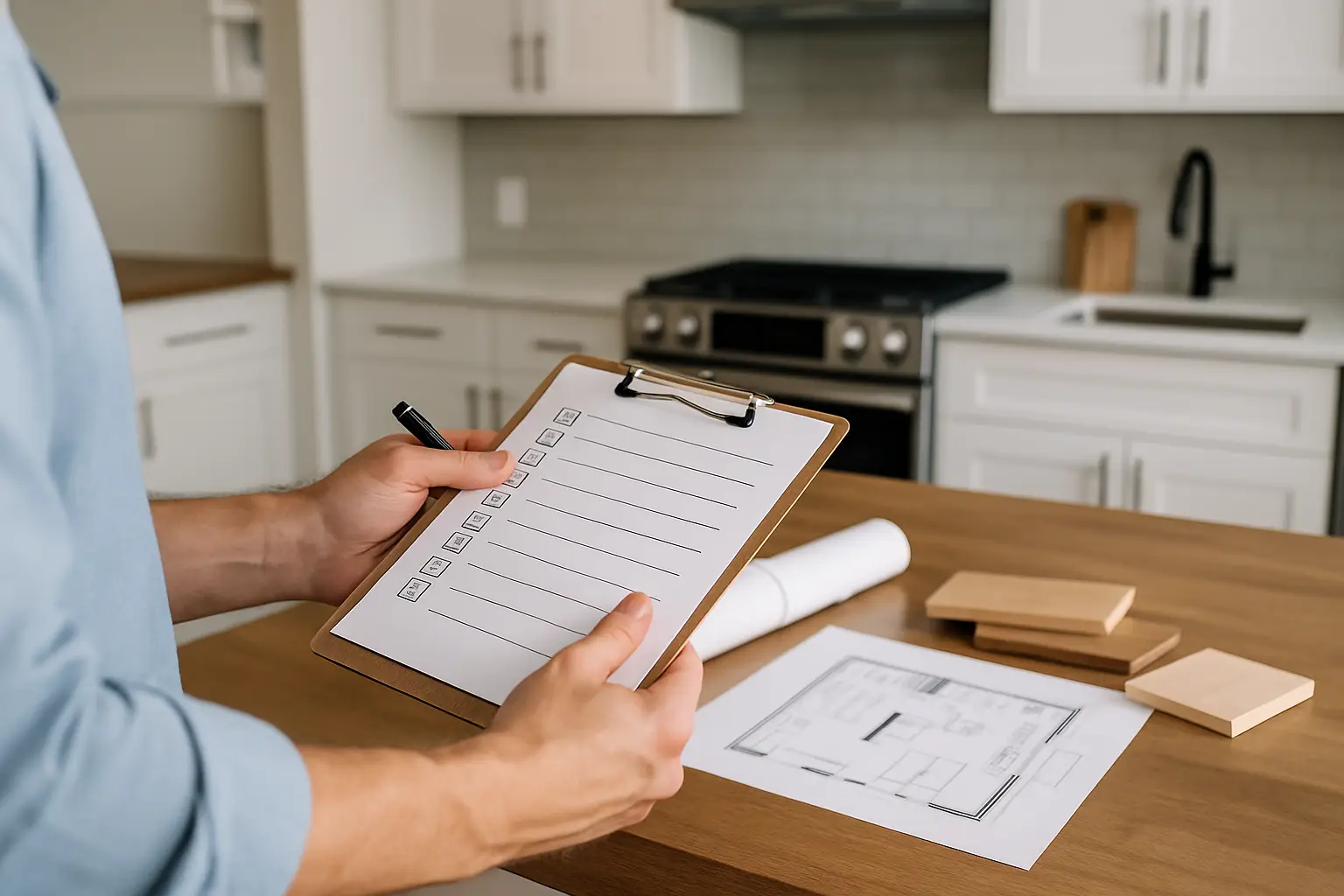
The fastest way to blow a kitchen budget is to start shopping before you’ve decided what you’re actually building. One “great deal” on cabinets turns into a sink that doesn’t fit, a range hood that can’t vent, and lighting that ends up centered on an island you later shrink by 6 inches. A kitchen remodel goes well when decisions happen in the right order – and when you’re honest about how you live.
This kitchen remodel planning checklist is built for real households: weeknight cooking, backpacks on the counter, coffee rituals, and the occasional “we’re hosting 10 people” scramble. Use it to move from ideas to a plan you can price, schedule, and execute with fewer surprises.
Step 1: Define your remodel “why” and your non-negotiables
Before you measure anything, get clear on what you’re solving. “I want it to look nicer” is valid, but it won’t guide trade-offs when you’re choosing between a bigger pantry and a larger island.
Start with three specifics: what frustrates you daily, what you wish you had, and what must stay. A few common non-negotiables are a more functional work triangle, better lighting, more landing space next to the stove, or a kid-friendly zone for snacks and homework.
It also helps to name your remodel type because it affects cost, timing, and risk. Cosmetic updates (paint, hardware, lighting, maybe countertops) behave very differently than a full gut remodel with layout changes. If you’re moving plumbing or gas, expect permits, inspections, and more time – but also a chance to fix long-standing layout problems.
Step 2: Set a budget that can survive real life
A kitchen budget needs two numbers: the target and the “still okay” ceiling. Your target is the plan you’re aiming for. Your ceiling includes a contingency for unknowns, especially in older homes.
A practical range for contingency is 10% for a straightforward refresh and 15-20% for a gut remodel, homes with older plumbing/electrical, or any plan that touches walls. This isn’t pessimism – it’s what keeps you from cutting the items that actually make the kitchen feel finished, like proper lighting or a good faucet.
As you build your budget, separate “fixed” costs (labor, cabinets, countertops, appliances) from “easy to expand” costs (tile details, pendant upgrades, specialty organizers). Those expandable items are where budgets quietly drift.
Step 3: Decide your timeline and your tolerance for disruption
A kitchen remodel is not just a project – it’s a temporary lifestyle. If you work from home, have small kids, or rely on your kitchen for daily routines, timeline matters as much as style.
If you’re hiring a contractor, ask for a realistic schedule and what could push it: special-order cabinets, countertop lead times, appliance backorders, or permit delays. If you’re DIY-ing parts of the project, be honest about how many hours you can actually dedicate each week.
Plan your “temporary kitchen” early. A microwave, coffee maker, dish tub, and a place to store daily plates can keep your home functional. If you’re relocating a fridge, confirm the outlet and pathway now – not on demolition day.
Step 4: Measure, document, and build a layout you can defend
Measurements are the backbone of every decision that follows. Take full room dimensions, ceiling height, window and door sizes, and the location of plumbing, gas, and electrical. Photograph every wall and the ceiling. Document how far doors swing and whether a drawer might crash into an adjacent handle.
Then focus on flow. Great kitchens minimize steps and bottlenecks. Think in zones: cooking, cleaning, prep, coffee, pantry, and “drop zone” for mail and bags. If you have multiple cooks, prioritize two clear work paths.
Here’s the trade-off most people miss: islands are fantastic, but only if you have enough clearance. If you have to squeeze walkways to “make the island happen,” you’ll feel it every day with open dishwasher doors, traffic jams, and bruised hips. Sometimes a peninsula or a slimmer island with more aisle space is the luxury move.
Kitchen remodel planning checklist: layout decisions to lock
Before you price cabinets or order appliances, you should be able to answer these layout questions with confidence:
- Are you keeping the sink, stove, and fridge locations, or moving one or more?
- Do you want seating at the island/peninsula, and how many seats actually fit comfortably?
- Where will trash/recycling live, and is it near prep space?
- Do you need a pantry cabinet, a closet pantry, or just smarter base storage?
- Where will small appliances park so counters stay usable?
If you want to sanity-check your plan visually, use a simple 3D sketch or layout tool to test clearances and cabinet runs before you commit. If you prefer a guided approach, you can also browse planning resources and room-by-room frameworks at Home Design United.
Step 5: Choose cabinetry strategy first (it affects everything)
Cabinets dictate your kitchen’s storage, function, and much of the budget. The big decision is not just color – it’s construction level and layout efficiency.
Stock cabinets are cost-friendly and quick but limit sizing. Semi-custom offers more flexibility for tricky spaces. Custom can solve anything, but it’s usually only worth it when you have unusual dimensions or strong functional priorities.
Now decide what “better storage” means for you. Deep drawers for pots, a pull-out spice rack near the cooktop, tray dividers for sheet pans, and a dedicated trash pull-out are everyday wins. It’s worth investing in function where you’ll touch it daily, even if you simplify elsewhere.
Step 6: Lock appliance sizes and ventilation before countertops
Appliances are not interchangeable rectangles. A 36-inch range changes cabinet spacing, hood sizing, and sometimes electrical and gas needs. A counter-depth fridge might look cleaner but can reduce capacity. A panel-ready dishwasher can elevate the design but raises the line item.
Ventilation is where style and performance meet. If you cook often, prioritize an appropriately sized hood with proper ducting. Recirculating options can be fine in some condos or tricky homes, but they don’t perform like vented systems. Decide early so your cabinetry, hood cover, and ceiling plan align.
Step 7: Plan lighting in layers (and wire it early)
Lighting is the difference between “pretty kitchen” and “I love being in here.” It also needs to be planned while walls are open.
Aim for three layers: ambient (general light), task (under-cabinet or focused work lighting), and accent (pendants, toe-kick glow, or interior cabinet lighting). If you’re updating electrical, add more outlets than you think you need, especially near where you’ll prep and where devices will charge.
Dimmers are a small upgrade that makes a big quality-of-life difference. Warm, comfortable evening light can make the kitchen feel like part of your living space instead of a work zone.
Step 8: Pick finishes in the right order to avoid expensive re-dos
Finishes feel fun – but the order matters. Start with the least flexible and most expensive items first.
Countertops and cabinets should lead the palette, then backsplash, flooring, and finally paint. If you’re keeping existing floors, bring a sample into every decision. If you’re changing flooring, confirm how it transitions to adjacent rooms. It’s okay to mix materials, but keep an eye on undertones so the space doesn’t fight itself (warm wood with icy gray, for example, can look accidental unless it’s intentional).
For durability, think about your household. Matte cabinets can hide fingerprints but may show grease near the stove. Gloss is easy to wipe but shows smudges. Quartz is low-maintenance, while natural stone can be stunning but may need sealing and more care. “Best” depends on how you cook, clean, and live.
Step 9: Decide what you’re outsourcing and vet your team
If you’re hiring help, your planning checklist should include the business details, not just the design.
Get clear on who does what: who orders materials, who is responsible for measurements, who pulls permits, and who coordinates trades. Ask how change orders are handled and how you’ll communicate day-to-day. The right contractor is not just skilled – they’re organized and transparent.
If you’re doing a hybrid approach (DIY demo, pro install), confirm the handoff points in writing. Many project delays happen in the gaps between “I thought you were doing that” and “I assumed it was included.”
Step 10: Confirm permits, building rules, and inspection timing
Permitting varies by location, but many kitchens require permits if you’re moving plumbing, adding circuits, changing gas lines, or altering walls. If you’re in a condo or co-op, your building may have additional approvals, work-hour restrictions, and insurance requirements.
Build inspection timing into the schedule. Drywall can’t close until rough inspections pass, and that affects everything that follows. This is one of the biggest reasons a “three-week remodel” turns into eight.
Step 11: Order materials with lead times in mind
Once your layout is finalized and your team is aligned, start ordering based on lead times, not excitement level. Cabinets, custom doors, appliances, and specialty tile can all take weeks (or longer).
Also confirm where items will be stored safely when they arrive. A quartz slab can’t sit in a driveway, and a new fridge doesn’t love a dusty construction zone. Planning storage protects your purchases and keeps the job site workable.
Step 12: Prep your home for the messy middle
Protect adjacent rooms with plastic barriers and floor coverings. Decide where debris will exit the home and how your contractor will manage dust. If you have pets, plan safe boundaries.
Then set up your temporary routine. Stock paper plates if needed. Move daily-use pantry items to a labeled bin. Keep one “real life” drawer for scissors, tape, and chargers so you’re not digging through boxes for basic things.
Step 13: Do a final pre-demo walkthrough (the last chance to catch gaps)
Right before demolition, walk the kitchen with your plan in hand. Confirm outlet locations, light placement, faucet reach, cabinet hardware style, trash pull-out location, and where fillers are needed.
This is also the moment to confirm small details that prevent daily annoyances later: where the dishwasher opens relative to the sink, whether a microwave door blocks a walkway, and how far upper cabinets sit from the ceiling. The goal is not perfection. It’s preventing the kind of “oops” that costs real money.
Step 14: Keep one “decision log” so nothing gets lost
Even small remodels involve dozens of choices. A simple decision log – a shared note or spreadsheet – keeps everyone aligned. Track paint color, grout color, cabinet finish, hardware sizes, faucet model, lighting temperatures, and delivery dates.
When you’re tired and the kitchen is half-demolished, this log becomes your calm, practical anchor.
Step 15: Plan the finishing touches that make it feel like home
Once the big installs are done, the space can still feel a little sterile. That’s normal. This is where comfort and personality come in.
Layer in details that match how you live: a washable runner in high-traffic zones, a stool height that’s actually comfortable, a spot for a fruit bowl that doesn’t steal prep space, and lighting scenes that work for mornings and evenings. If you’re adding smart home features, start simple – like dimmers or under-cabinet lights on a schedule – and build from there.
A kitchen remodel is a lot of decisions, but it doesn’t have to feel overwhelming. Treat your plan like a promise to your future self: fewer daily hassles, more comfort, and a space that supports your routines instead of fighting them.