







You know that moment when you walk into someone’s living room and it just feels finished – not fancy, not fragile, just pulled together? That “effortless” look usually comes from a handful of decisions made on purpose: where the seating lands, how the light layers, what scale the rug is, and which few pieces get to be the stars.
This guide focuses on interior decoration ideas for living room updates that improve how the room looks and how it works. You can do a few in one weekend or take them one by one, depending on budget and time.
Start with the room’s job (then design for it)
A living room can be a movie room, a conversation hub, a play zone, a reading nook, or all of the above. Before you buy anything, name your top two uses. This is the fastest way to avoid a room that’s pretty but annoying.
If your real life includes kids, pets, or constant snacking, you’ll likely prefer performance fabrics, closed storage, and surfaces that forgive fingerprints. If the space is mostly for hosting, you can prioritize extra seating, flexible drink surfaces, and lighting that flatters at night.
Interior decoration ideas for living room layout that actually flows
Layout is the quiet hero of living room design. The best decor in the world can’t rescue a traffic jam between the sofa and the hallway.
Anchor the conversation zone
Most living rooms feel better when seating “faces” something – a fireplace, a media wall, a view, or simply each other. If you can, float the sofa so it relates to the chairs and coffee table instead of clinging to the wall. In small rooms, floating can still work – even 6-10 inches off the wall can look intentional.
A quick rule that helps: aim for 14-18 inches between the sofa and coffee table. It’s close enough to reach a drink, far enough to walk through.
Make pathways obvious
Try to keep main walkways around 30-36 inches wide. In tighter spaces, 24 inches can be workable, but you’ll feel it. If your room always feels cramped, the issue may be one oversized piece (often the coffee table or extra chair) stealing the route.
Color that looks cohesive, not “matched”
A living room feels designed when the color palette repeats across the room in small ways – pillows, art, books, a throw, a vase – rather than showing up once on an accent wall and disappearing.
Pick a base, then build contrast
A reliable formula is: one dominant neutral (walls, large upholstery, rug background), one supporting color (curtains, chairs, or a big art piece), and one accent (pillows, ceramics, small decor). The contrast is what keeps neutrals from feeling flat.
If you love bold color, put it where it’s easy to edit later: pillows, throws, and art. Paint is also editable, but it’s more time and disruption, especially in open-concept homes.
Use undertones to avoid “almost” clashes
Not all whites are friends. If your sofa is a warm cream and your wall is a cool bright white, the room can look slightly off even if you can’t explain why. When in doubt, choose either mostly warm neutrals (creams, taupes, warm grays) or mostly cool neutrals (crisp whites, cool grays) and let wood tones bridge the gap.
Lighting: the fastest way to make the room feel upgraded
If your living room relies on one overhead fixture, the space will usually feel harsher and less cozy at night. Layered lighting is one of the most “expensive-looking” changes you can make without remodeling.
Aim for three layers
You want a mix of ambient light (overall glow), task light (reading, puzzles, working), and accent light (highlighting art or architectural features). That might look like a ceiling fixture, a floor lamp near the sofa, and a table lamp on a console.
Warm bulbs (around 2700K) tend to feel more relaxing in living rooms. Dimmers are a game-changer, but even without rewiring, you can use plug-in dimmers for lamps.
Don’t ignore shade and scale
A tiny lamp on a big end table looks like an afterthought. Bigger shades cast softer light and feel intentional. If you’re choosing between two sizes, the slightly larger one is often the better design choice.
Rugs: size is everything
A rug that’s too small can make a living room look like it’s wearing shoes two sizes down. If you only change one thing, change the rug size.
The most common “right” move is getting the front legs of the sofa and chairs on the rug, or going fully under all seating if the room allows. In open layouts, a larger rug also helps define the living zone so it doesn’t feel like furniture floating in space.
Pattern is practical, too. If you have kids, pets, or frequent guests, a lightly patterned rug hides life better than a solid pale one.
Curtains that add height (even in a rental)
Window treatments are often the missing piece. They soften the room, control glare, and make the architecture feel more finished.
Hang curtain rods higher than the window frame when you can, and extend the rod beyond the window so the curtains stack mostly on the wall, not blocking glass. It makes windows look larger and brings a tailored feel.
If you’re renting or avoiding holes, look for no-drill rod options or use a clean-lined shade paired with fabric panels to get that layered look.
Art and walls that feel personal, not generic
Blank walls can make even nice furniture feel temporary. But wall decor works best when it reflects you – not when it fills space just to fill it.
Go bigger than you think
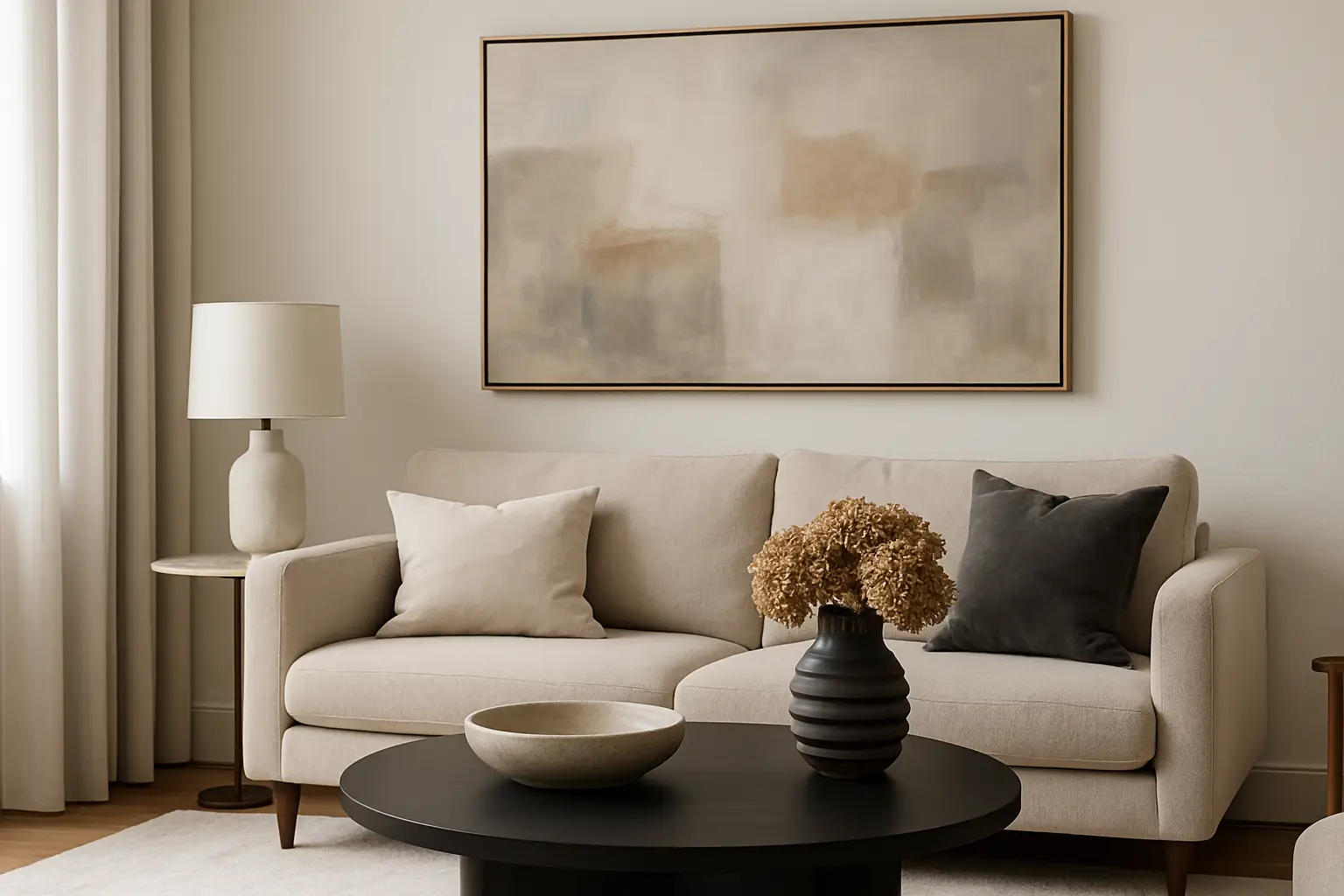
A common mistake is choosing art that’s too small for the wall or hanging it too high. Over a sofa, a single large piece or a well-scaled pair usually reads more polished than several tiny frames scattered.
If you’re building a gallery wall, keep one unifying element: consistent frame color, a repeating mat style, or a tight color palette. That’s what makes variety feel curated.
Add one “texture moment”
Not all wall decor needs to be framed. A woven piece, sculptural wall art, or even a large mirror can add depth. Mirrors also bounce light, which helps in darker living rooms or north-facing spaces.
Styling that looks intentional (and stays livable)
The goal isn’t to make your living room look like a photo shoot. It’s to make it feel put together on a normal Tuesday.
Edit surfaces, then group what stays
Clutter reads louder than most people realize. Clear the coffee table and side tables completely, then add back a few items in a simple grouping: a tray, a book stack, a candle, a small plant. Leaving some negative space is what makes it feel calm.
If you need everyday function, choose “pretty useful” items: a lidded basket for remotes, a tray to corral coasters, a storage ottoman that hides toys or blankets.
Mix materials to avoid the showroom look
If everything is smooth and shiny, the room can feel cold. If everything is soft, it can feel a little flat. Mixing wood, metal, glass, and textiles makes a space feel layered. Even small swaps help: a woven basket next to a sleek lamp, or a nubby throw on a leather chair.
Budget-friendly upgrades with high impact
Not every upgrade requires a new sofa. A few targeted changes can shift the whole room.
Swapping throw pillows (and using inserts that look full rather than floppy), adding a larger rug, updating lamp shades, or replacing generic hardware on a media console can all read as a refresh. If your walls are scuffed or patchy, a clean paint job is still one of the best returns on effort.
If you want a “designer” trick: repeat one finish three times. For example, black metal in a floor lamp, picture frames, and a side table detail. Repetition builds cohesion.
A little tech can make decorating easier
If you struggle to visualize, you’re not alone. Simple AI room planners and 3D layout tools can help you test rug sizes, sofa orientation, and color palettes before you commit. The trade-off is that digital mockups can miss real-world undertones and texture, so it’s still smart to sample paint and see fabrics in your actual lighting.
For more room-by-room planning support, Home Design United shares practical design playbooks at https://homedesignunited.com/.
Style directions you can execute without starting over
If you’re drawn to a specific look, you don’t need to replace everything. You need a few “signal” choices that steer the room.
Modern farmhouse (without the clichés)
Focus on warm woods, matte black accents, and comfortable upholstery. Skip overly themed signs and lean into texture: a linen-look sofa, a chunky knit throw, and simple pottery.
Scandinavian calm
Light walls, pale woods, and clean lines work best when balanced with cozy textiles. Add contrast with black frames or a charcoal rug so the room doesn’t feel washed out.
Boho chic (but controlled)
Boho looks best when it has boundaries. Pick a consistent palette, then layer in pattern through pillows and rugs. Use closed storage so the styling feels intentional instead of chaotic.
Minimalist (still welcoming)
Minimalism isn’t empty – it’s edited. Keep fewer, better pieces, prioritize hidden storage, and bring warmth with natural textures like wool, wood, and linen.
The living room “finish line” test
When the room feels close but not quite there, check these three things: scale (is anything too small?), light (do you have at least two lamp sources?), and softness (are there enough textiles to absorb sound and make it feel comfortable?). Usually, one of those is the missing link.
Pick one idea from this list that improves function and one that improves mood, and do them in the same week. Your living room will feel more like a reflection of your personality – and more like a place you actually want to spend time in.