








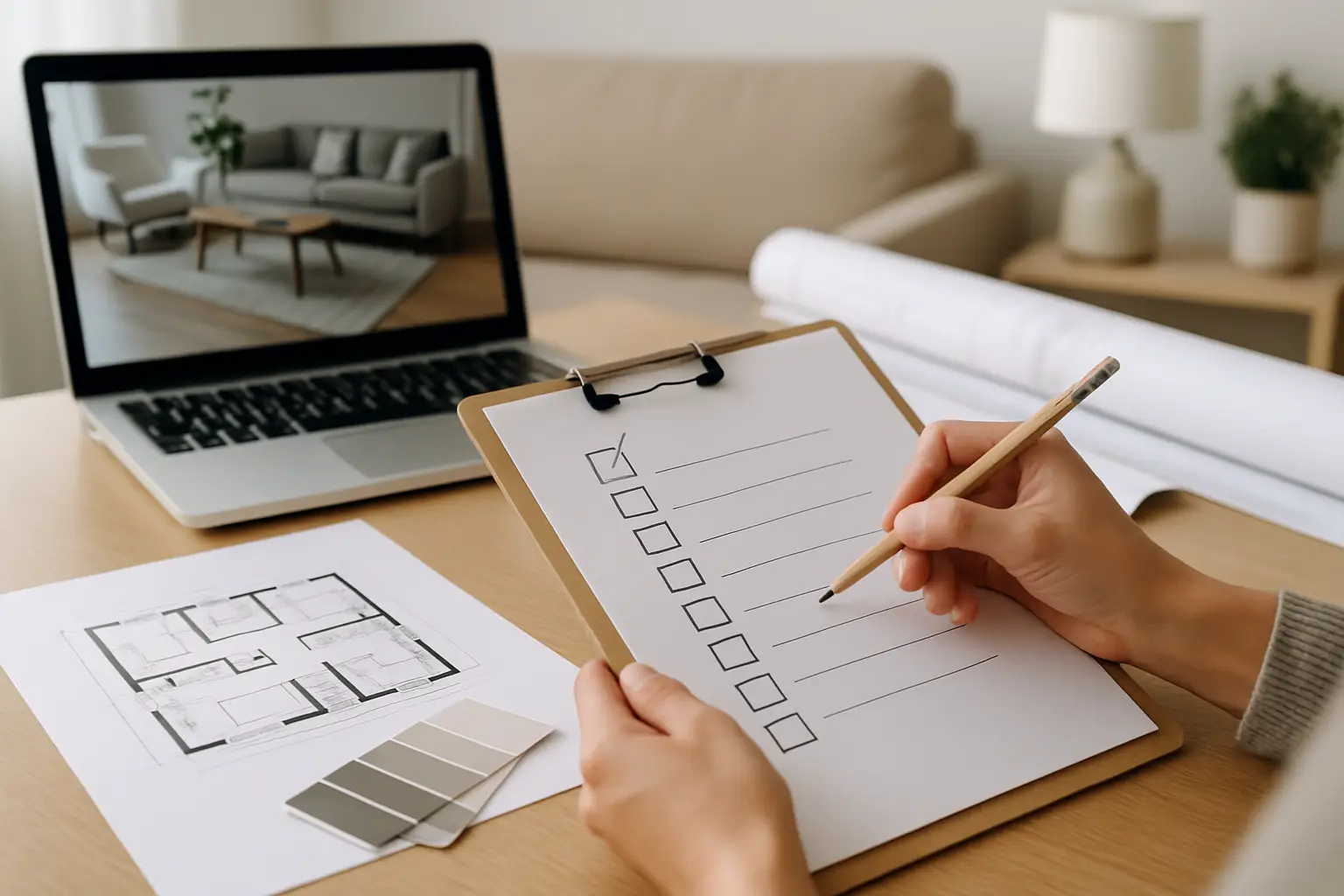
You know that feeling when you stand in the middle of a room and think, “I don’t hate it… but I don’t love it either”? Beginners often assume the fix is buying a new rug or painting a wall. Sometimes that works. More often, the room still feels “off” because the real issue is sequence – making design decisions out of order.
This home design checklist for beginners that works is built to keep you moving in the right order so your choices stack up into a space that looks pulled together and works better day-to-day.
This is a Home Design Checklist for Beginners That Works that will guide you through the essential steps.
Start with your real-life brief (not your Pinterest board)
Essential Home Design Checklist for Beginners That Works
Before you measure anything or pick a color, get clear on how the space needs to behave.
Ask yourself: Who uses this room, and what are they doing in it most days? A living room that’s really a family movie zone needs different seating and lighting than one that’s mainly for hosting. A “guest room” that doubles as a home office has to earn its square footage.
This Home Design Checklist for Beginners That Works ensures you make the right choices in your design journey.
Also decide your non-negotiables. Maybe it’s “a place to put down keys and bags,” “no white sofa because of the dog,” or “a reading chair with a real lamp.” These constraints aren’t limiting – they’re how you design a home that feels like you.
Measure, photograph, and map the pain points
Beginners skip this because it feels slow. But five minutes with a tape measure will save you five hours of returns.
Measure wall lengths, ceiling height, window dimensions, and the distance from floor to window trim (important for curtain placement). Note outlets, vents, radiators, and any doors that swing into the room. Then take photos from every corner in natural daylight and again at night with the lights on.
As you do this, write down what isn’t working right now. Maybe the hallway feels cramped because a console is too deep. Maybe the bedroom looks messy because there’s no closed storage. Those “annoyances” are your design to-do list.
Set a budget with priorities (and one flex category)
Utilizing a Home Design Checklist for Beginners That Works helps you allocate your budget effectively.
A smart budget isn’t just a number – it’s a plan for where quality matters.
For most rooms, prioritize comfort and scale first: seating you actually want to sit in, a mattress you don’t regret, rugs large enough to anchor furniture. Save on trend-driven items that you may want to swap later, like throw pillows or a sculptural side table.
Build in a flex category (even if it’s small). Something always comes up: shipping fees, better curtain rods, a different paint finish, a surprise electrician visit for a ceiling box. Flex money keeps the project from stalling.
Choose a style direction you can repeat
For a cohesive look, refer back to your Home Design Checklist for Beginners That Works.
You don’t need a single strict style, but you do need a repeatable rule set.
Pick two to three style words that guide decisions. For example: “warm modern,” “cozy minimal,” “classic coastal,” or “modern farmhouse but not rustic.” Then choose one grounding neutral you can repeat across rooms (a warm white, greige, soft taupe, or gentle gray) plus one consistent wood tone direction (light oak, medium walnut, or painted).
This is how beginners avoid the “every room is a different universe” problem.
Build the layout before you buy anything
Following a Home Design Checklist for Beginners That Works can streamline your purchasing decisions.
If you only follow one step in this beginner home design checklist, make it this one.
Start with traffic flow. People should be able to walk through a room without turning sideways or bumping into furniture corners. Then anchor the room with the largest pieces first – usually the sofa, bed, or dining table – and work outward.
A common trade-off: pushing furniture against walls can create more open floor in the center, but it can also make the room feel like a waiting area. Floating a sofa or pulling chairs in can feel more intentional, but only if you keep pathways clear.
If you’re using 3D home design software or an AI room planner, treat it as a fast draft, not a final answer. Tools help you test scale quickly, but you still need real measurements and your real habits to guide decisions.
A clear Home Design Checklist for Beginners That Works can clarify your design intentions.
Pick your color plan the right way
Most beginners start by choosing a paint color. A better approach is choosing a palette.
Start with what you can’t easily change: flooring, large tile, countertops, or a dominant brick/stone element. Then select your large soft surfaces: rug and curtains (or at least one of them). After that, choose paint.
Why? Paint has near-infinite options. Rugs and textiles do not. It’s easier to match paint to a rug than match a rug to the “perfect” paint.
If you want the room to feel bigger and calmer, keep contrast lower (soft walls, similar-value trim, cohesive neutrals). If you want energy and definition, increase contrast (deeper wall color, crisp trim, darker accents). Neither is “right.” It depends on your light levels and how you want the room to feel.
Layer lighting so the room works all day
Layer your lighting according to your Home Design Checklist for Beginners That Works for better ambiance.
Lighting is one of the fastest ways to take your home to the next level – and one of the most ignored by beginners.
Aim for three types: ambient (overall), task (what you need to see), and accent (what you want to highlight). In a living room, that might mean a ceiling fixture or flush mount for ambient, a reading lamp for task, and a small lamp or picture light for accent. In a kitchen, it’s often recessed or a central fixture plus under-cabinet task lighting.
A key “it depends” point: If you love a cozy vibe, prioritize warm bulbs and lamps over harsh overhead lighting. If you need crisp visibility for cooking, makeup, or detail work, you may want a slightly higher brightness and dedicated task lights.
Choose furniture by scale, function, and maintenance
Applying the Home Design Checklist for Beginners That Works will help you avoid impulse buys.
Furniture shopping is where beginners get pulled into impulse buys. Use three filters.
First: scale. A gorgeous sofa that’s too large will make the room feel tight forever. Check depth and length, not just “looks big/small.” Second: function. If you don’t have storage, consider an ottoman with a lid, a bed with drawers, or closed cabinets instead of open shelving. Third: maintenance. If your home is busy (kids, pets, frequent hosting), performance fabrics and wipeable finishes will feel like a luxury.
For rugs, go bigger than you think. Undersized rugs make rooms feel smaller and furniture look awkwardly scattered. In living rooms, a common guideline is front legs of major seating on the rug; in dining rooms, the rug should extend far enough that chairs stay on it when pulled out.
Plan storage like a system, not a pile of bins
Effective storage solutions align with your Home Design Checklist for Beginners That Works.
Clutter isn’t a personality flaw. It’s usually a storage design issue.
Start by identifying what needs to live in the room. Then decide what should be visible (pretty books, ceramics, a curated basket) and what should be hidden (paperwork, cords, cleaning supplies). Closed storage makes a space feel calmer quickly, especially in small apartments or open-concept homes.
Don’t forget the “drop zone.” An entryway hook rail, a tray on a console, or a small basket for mail prevents daily mess from migrating to the kitchen counter.
Add the finishing layers that make it feel intentional
The final touches should reflect your Home Design Checklist for Beginners That Works.
This is the part people rush, but it’s what makes a room feel styled instead of simply furnished.
Window treatments: Hang curtains higher than you think and wide enough that they can stack off the glass. This makes windows look larger and ceilings feel taller.
Art and wall decor: Art that’s too small is a beginner classic. If you’re unsure, go bigger or group pieces into a clear arrangement. Hang art so the center sits roughly at eye level, adjusting for tall headboards or sofas.
Textiles: Mix textures (linen, knit, velvet, woven) even if you keep colors neutral. Texture is how minimal palettes still feel warm.
Greenery: A plant or even a realistic faux tree adds life and softens hard edges. Pick a size that matches the room – tiny plants tend to disappear in big spaces.
Do a “one-week test” before you lock it in
Testing your layout against a Home Design Checklist for Beginners That Works will ensure satisfaction.
Before you declare the room finished, live with it for a week.
Notice what you reach for, what you avoid, and what annoys you. Maybe the coffee table is too far from the sofa. Maybe the bedside lamp is too dim. Maybe the rug slides every time you walk in. These are small fixes that make a huge difference in how the space supports your routine.
If you want more room-by-room planning help and trend-forward ideas you can actually use, Home Design United is built for practical upgrades like this.
A quick beginner checklist you can screenshot
This checklist is your Home Design Checklist for Beginners That Works, so keep it handy.
Use this as your fast pass when you’re tempted to buy decor first:
-
- Define the room’s job and your non-negotiables
- Measure everything and note obstacles (doors, vents, outlets)
- Set a budget with priorities and a flex category
- Choose 2-3 style words and a repeatable neutral
- Confirm the layout and walking paths
- Build a palette: fixed finishes, textiles, then paint
- Layer lighting: ambient, task, accent
- Buy furniture by scale, function, and maintenance needs
- Design storage around what actually lives in the room
- Finish with curtains, art, textiles, and greenery
- Live with it for a week and make small adjustments
Remember, your Home Design Checklist for Beginners That Works is a living document.
Design confidence doesn’t come from getting everything “right” on the first try. It comes from making decisions in the right order, noticing what works in your real life, and giving yourself permission to refine as you go – because a home that feels personal is always a work in progress.