







That moment when the coffee table you love looks “off” next to your floors can make you question every design choice you’ve ever made. The good news: mixing wood tones isn’t a mistake – it’s often the reason a room feels layered, lived-in, and intentionally designed. The trick is learning how to mix wood tones with a few repeatable rules so your space feels cohesive, not chaotic.
Why mixed wood tones usually look better than “matching”
Perfectly matched wood sets can read flat or builder-basic, especially in open-concept homes where the same finish repeats from room to room. Real homes collect pieces over time: a hand-me-down dresser, a new dining table, existing floors you’re not replacing. When you mix wood tones well, you create contrast, depth, and a more personal look.
There’s a trade-off, though. The more wood surfaces you introduce, the more important your plan becomes. Two wood tones can look casually intentional. Five different tones without a strategy can start to feel like a showroom clearance aisle.
Start with the “fixed” wood tone in your home
Before you think about furniture, identify what isn’t changing soon. In most homes, that’s the floor. In rentals, it might be the cabinets. In older homes, it could be stained trim or a brick-and-wood fireplace surround.
Treat this fixed element as your anchor. You’re not trying to match it. You’re deciding how everything else will relate to it: lighter, darker, warmer, cooler, or similar but clearly different.
A helpful mindset: your anchor wood is the “baseline” in the room. Every other wood tone should either complement it or contrast it on purpose.
Understand undertones (this is where most rooms go wrong)
When people say woods “clash,” they’re usually reacting to undertones, not the lightness or darkness.
Wood tones tend to fall into a few undertone families:
- Warm: red, orange, honey, golden, amber
- Cool: gray, ash, weathered, taupe-leaning
- Neutral: balanced browns, some walnuts, many natural oaks (depending on finish)
Here’s how to use that knowledge without overthinking it. Stand near your anchor wood in daylight and ask: does it read more orange/red (warm) or more gray/ashy (cool)? Then make a call.
If your anchor wood is warm, you’ll usually get the cleanest result by keeping most other wood tones warm or neutral. If your anchor is cool, stay cool/neutral for the majority.
“It depends” moment: some of the best interiors mix warm and cool woods, but they do it with strong contrast and repeated accents so it feels curated. If you’re a beginner or you want a foolproof plan, align undertones first.
Use contrast on purpose: the 2- to 3-tone sweet spot
For most everyday homes, the easiest formula is to use two to three wood tones per room:
- Your anchor (often the floor)
- A secondary wood tone (often the largest furniture piece)
- An accent wood tone (smaller pieces, frames, stools)
This prevents the “almost matching” problem, where two woods are close but not identical and end up looking accidental.
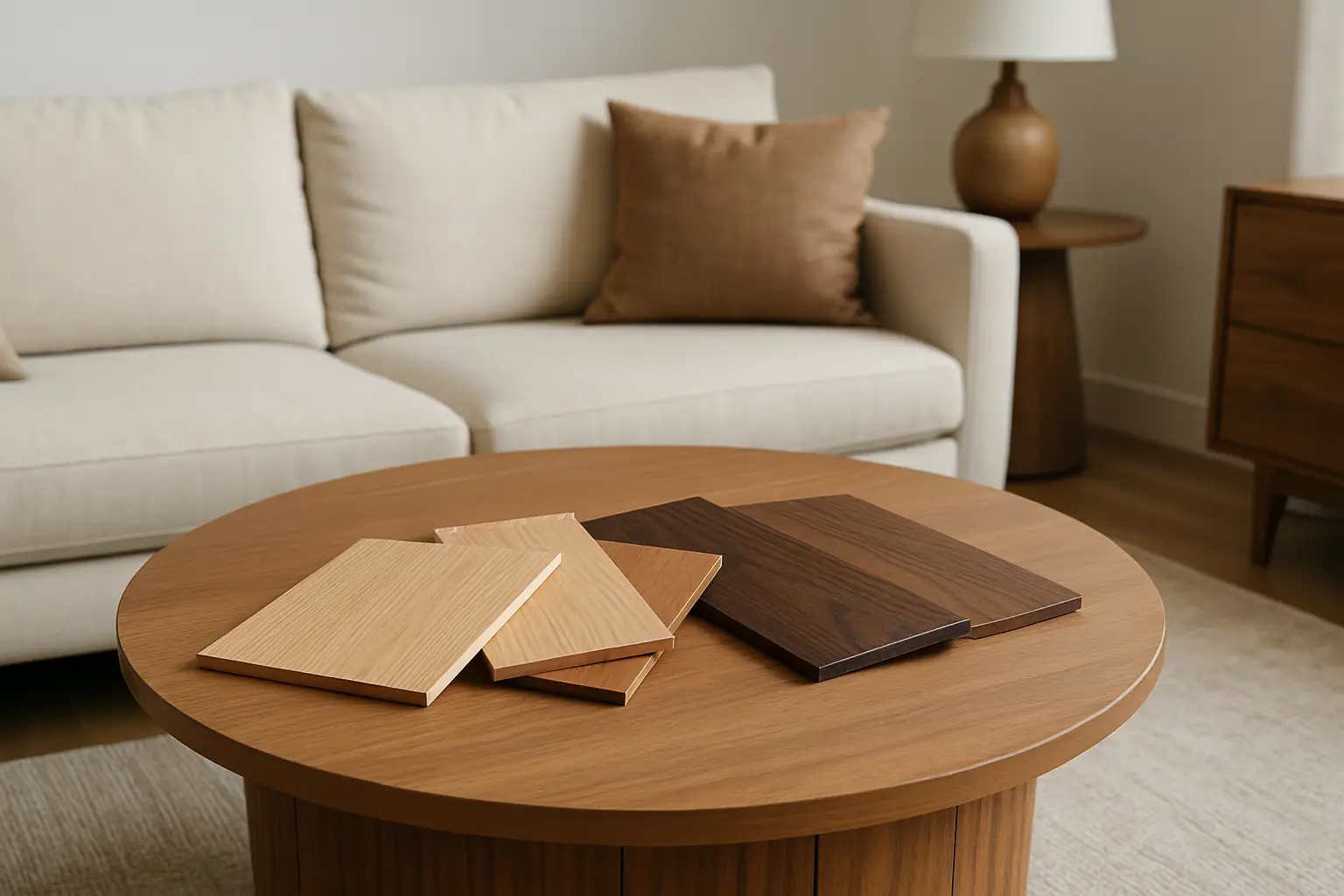
A simple rule that works: if you’re not matching, separate your tones by at least a few shades. Pair light with medium, medium with dark, or light with dark. The bigger the difference, the more intentional it looks.
For example, honey oak floors tend to look great with a darker walnut coffee table or espresso-toned dining chairs. If you choose another honey wood that’s just slightly different, the room can feel like a near-miss.
Repeat wood tones so they feel intentional
Designers rarely use a wood tone only once. Repetition is what makes “mixed” look “planned.”
If you introduce a walnut dining table, echo that walnut again – maybe in picture frames, a mirror frame, a small side table, or a shelf bracket. You don’t need a matched set. You’re creating visual rhythm.
A practical way to do this: for every new wood tone you bring in, aim to repeat it at least twice in the room (even if the second repeat is small).
Let one wood tone lead and keep the others supporting
When everything is competing, nothing feels calm. Pick the “lead” wood tone for the room – typically the largest piece of furniture after the floor (sofa table, bed frame, dining table, or built-ins).
Then keep the other wood tones quieter: slimmer profiles, smaller surface area, or more subtle grain. A chunky rustic table plus chunky rustic media console plus chunky rustic bed can overwhelm fast.
If your lead piece is dramatic (high-contrast grain, reclaimed texture, very dark stain), consider simpler supporting woods in smoother finishes. This is especially helpful in modern or transitional spaces.
Mix finishes like you mix fabrics: matte, satin, and texture
Wood tone is only half the story. Finish and texture do a lot of work in making a room feel cohesive.
If you have glossy, red-toned cherry cabinets and you add a glossy, orange-toned table, the shine will amplify the mismatch. But if you add a matte or wire-brushed piece in a deeper tone, the different sheen can make the contrast feel intentional instead of “wrong.”
Texture also helps bridge gaps. Rattan, cane, raw-edge wood, and lightly distressed finishes act like neutrals because they read as natural variation.
Room-by-room: how to mix wood tones in real spaces
Living room
Living rooms often have the most wood pieces at once: floors, coffee table, media console, side tables, shelves, frames.
If your floors are medium warm (oak, maple, hickory), choose either a darker anchor furniture tone (walnut/espresso) or a lighter, washed wood that clearly separates. Then repeat that secondary tone in two smaller moments.
To keep it from feeling “too brown,” add soft contrast through rugs, upholstery, and black or antique brass metal. Metal finishes are a quiet bridge between different woods.
Kitchen and dining
Kitchens are where people get stuck because cabinets feel permanent and dominant.
If you have wood cabinets, treat them as your anchor and bring in a dining table that’s either clearly lighter or clearly darker. If you have painted cabinets but wood floors, the floors become the anchor and the table can be the secondary.
A common win: warm wood cabinets + a darker dining table + lighter wood stools, with a repeated metal finish (black or brass) tying everything together.
“It depends” moment: if your countertop has strong movement (busy granite, bold veining), keep wood tones simpler and fewer. Let the stone be the star.
Bedroom
Bedrooms feel best when they’re calm, so limit competing wood tones.
If you have a wood bed frame, let that be the lead. Choose nightstands in either the same family but clearly lighter/darker, or go painted to reduce wood overload. If you love a mixed look, add one small accent wood tone via a bench, picture frames, or a dresser top.
Bathrooms
Bathrooms are often small, which means contrast reads stronger.
If you have a wood vanity, keep other wood minimal. Use one supporting wood tone at most (like a teak stool or shelf). In bathrooms, repeating the same wood tone twice is usually enough.
The easiest “bridge” elements when woods don’t match
Sometimes you already own pieces that don’t naturally play well together. You don’t have to start over.
Use bridge elements that sit between tones or distract the eye:
- A large area rug (especially in a pattern that includes both warm and cool notes)
- Upholstery and textiles (linen, boucle, leather) to break up wood-on-wood
- A consistent metal finish (matte black, brass, nickel) repeated 2-3 times
- Painted pieces (black, soft white, or a muted color) to reduce the number of competing wood surfaces
If you want a fast planning shortcut, build a simple mood board with photos of your anchor wood plus your top 2-3 furniture pieces. Even a quick collage makes undertone issues obvious. Home Design United’s room-by-room guides at https://homedesignunited.com/ are also designed to help you make these decisions in a more visual, step-by-step way.
Common mistakes that make mixed wood tones feel accidental
The biggest mistake is choosing woods that are too close in color but different in undertone or grain. That’s when pieces look like they were meant to match and failed.
Another common issue is introducing too many “statement” woods at once: bold grain, heavy distressing, high shine, or very dark stains on multiple large pieces. If you want variety, keep at least one of these variables calm.
Finally, don’t forget lighting. Warm bulbs can push woods more golden; cool daylight can pull gray tones forward. If a pairing feels borderline, check it at different times of day before you commit.
A simple decision rule you can use every time
When you’re standing in a store (or scrolling online) and you’re unsure, ask two questions:
Does this piece clearly contrast with my anchor wood, or does it intentionally coordinate?
And: can I repeat this wood tone somewhere else in the room so it looks planned?
If you can answer yes to both, you’re almost always safe.
Your home doesn’t need perfect matches to feel polished. It needs choices that look like you made them on purpose – and once you see mixed wood tones as a tool (not a problem), you’ll start designing with confidence instead of second-guessing every finish you bring through the door.