







If your living room only works when nobody’s in it, the issue usually isn’t your style – it’s your layout. In small spaces, the wrong sofa depth, one oversized coffee table, or a “floating” chair that blocks the walkway can make the whole room feel cramped and inconvenient. The good news: a smart small living room furniture layout is less about buying tiny furniture and more about placing the right pieces in the right relationship to each other.
Below is a practical, design-forward way to plan your room so it feels open, comfortable, and actually livable – whether you’re in an apartment, a townhouse, or a snug family room that has to do it all.
Start with two measurements that matter
Before you move a single thing, measure the room’s length and width, then note every door swing, window, vent, and outlet. But don’t stop there. The two measurements that drive almost every small-space decision are your main walkway width and your TV-to-seating distance.
For walkways, aim for about 30-36 inches in the primary path (entry to sofa, sofa to hallway). You can go slightly tighter in a low-traffic corner, but if your main path is narrower than 30 inches, the room will always feel like an obstacle course.
For TV distance, a comfortable range is often 1.5-2.5x the screen’s diagonal size (depending on preference and resolution). This matters because it tells you how deep your seating zone can be. If the room is too short to hit a comfortable distance, you’ll want a smaller TV, a wall-mounted option, or a layout that doesn’t force the screen onto the shortest wall.
Choose one “anchor” and let everything else support it
Small rooms go sideways when you treat every piece like a star. Pick one anchor: either the sofa (most common), the TV wall (when entertainment drives the room), or the window/fireplace (when the room is more about lounging and conversation).
Once you choose the anchor, your job is to protect it from clutter. That means resisting extra side chairs “just in case” and focusing on a clean perimeter around the main seating. You’re not decorating less – you’re editing harder.
The most reliable small living room furniture layout: sofa + two flexible pieces
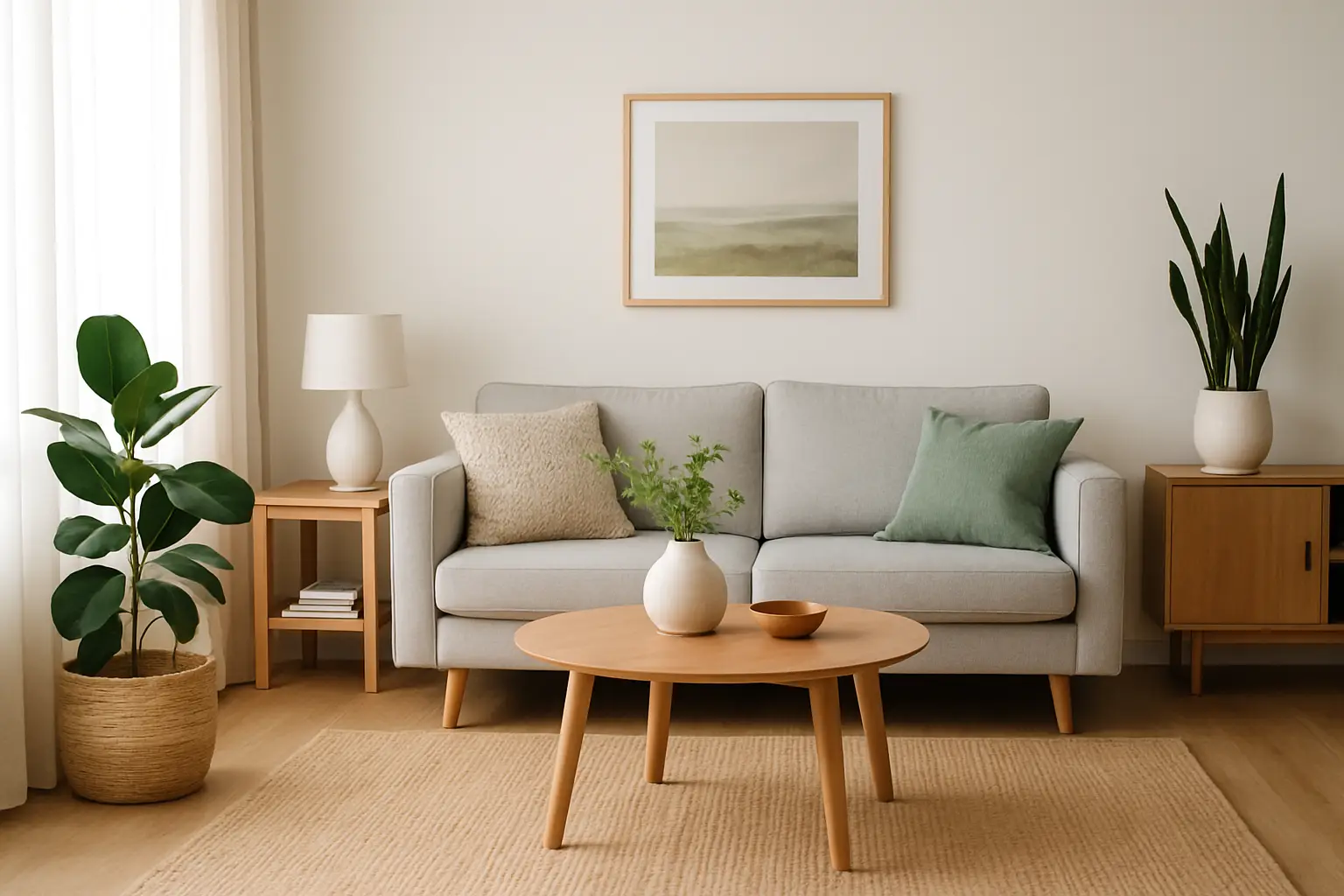
If you want a layout that works in most small living rooms, start here: place the sofa on the longest uninterrupted wall (or floated slightly off it if that improves circulation), then add two flexible pieces opposite or adjacent.
Those flexible pieces can be a pair of compact swivel chairs, one chair plus an ottoman, or even two poufs that can slide under a console when you’re not using them. Swivel chairs are especially helpful because they let one seat serve two zones – TV and conversation – without needing extra square footage.
Keep the coffee table light visually. A round table often navigates tight clearances better than a rectangle, and a nesting set gives you surface area only when you actually need it.
When the room is long and narrow
Long, narrow living rooms are common in apartments and older homes. The mistake here is lining everything up like a hallway. Instead, build a clear lane on one side of the room, then create a defined seating zone on the other.
Put the sofa along the long wall and keep it as slim as comfort allows. Then place either a chair angled at the sofa or a loveseat opposite if the width permits. If the TV must live in the room, consider mounting it on the short wall at one end and placing the sofa facing it, but only if you can keep that primary walkway open.
A narrow console behind a floated sofa can be a game-changer – it gives you a drop zone for keys, adds a place for lamps, and visually “finishes” the back of the sofa. The trade-off is depth: if adding a console forces your walkway under 30 inches, skip it and use wall-mounted lighting instead.
When the room is more square
Square rooms often feel tricky because there’s no obvious “best wall.” In a small square living room, avoid pushing everything to the edges and leaving an empty center. That emptiness reads like wasted space, and the furniture feels disconnected.
Try an L-shaped seating moment: a standard sofa plus a chaise, or a sofa paired with an ottoman that functions like a chaise when you put a tray on it. Then place one chair in a corner, slightly angled inward, to complete a conversational triangle.
If you’re doing a TV, pick one wall to dedicate to it and keep the media unit low and minimal. In small square rooms, tall, heavy entertainment centers can dominate the entire space. A floating shelf-style unit or a low cabinet typically looks cleaner and gives you storage without shouting for attention.
If your living room shares space with dining or a home office
Open-plan small spaces need zoning more than they need furniture. Your layout should communicate where living ends and dining or working begins, without building walls.
The simplest way: let the back of the sofa create the boundary. Float the sofa so it faces the TV or focal point, then place a slim desk or a narrow console behind it if space allows. If you’re blending living and dining, a small round dining table often flows better than a rectangle because it doesn’t create sharp corners in your walkway.
Rugs are your best zoning tool, but only if they’re sized correctly. A too-small rug makes the seating feel like it’s perched on an island. In most small living rooms, you want at least the front legs of the sofa and chairs on the rug so the zone reads as one intentional area.
Scale beats “small furniture” every time
A common misconception is that small rooms need miniature furniture. What they actually need is furniture with the right proportions and visual weight.
Look for sofas with higher legs, slimmer arms, and a shallower depth if the room is tight. A sofa that’s a few inches less deep can improve circulation dramatically. For chairs, choose pieces with open sides or an airy profile instead of bulky club chairs.
There’s also a counterintuitive truth: sometimes one appropriately sized sofa looks better than a loveseat plus extra chairs. Too many pieces create visual clutter and choke your walkways. If you want the room to feel bigger, fewer pieces with clearer purpose usually wins.
Put clearance rules to work (without making the room feel rigid)
Clearance guidelines keep a small living room functional, but you don’t need to treat them like a code book. Use these as targets:
- Leave about 14-18 inches between the sofa and coffee table (enough to walk and reach).
- Aim for 30-36 inches for primary walkways.
- Give yourself 3-5 inches between furniture and curtains so fabric can hang naturally.
If your room can’t meet every guideline, prioritize the path people walk most. A slightly tight coffee-table clearance is easier to live with than squeezing past the sofa every single day.
Storage that supports the layout, not the clutter
Small rooms feel smaller when surfaces become storage. The goal is to build storage into the perimeter so your seating zone stays calm.
A closed media console, a lift-top coffee table, or an ottoman with hidden storage can replace multiple baskets and bins. If your walls can take it, one vertical storage piece (like a tall cabinet) is often better than three small pieces scattered around the room.
Keep open shelving limited and intentional. Open shelves can look great, but in small living rooms they become visual noise fast. If you love the look, mix closed storage on the bottom with a few styled shelves above.
Light and tech choices that make the room easier to live in
Layout isn’t just where furniture goes – it’s how you use the room at night, during work calls, and on weekends.
Wall-mounted sconces or plug-in swing-arm lamps free up end-table real estate. A single floor lamp with an arched arm can light a seating zone without needing multiple small lamps. If you’re adding smart lighting, set scenes for “TV,” “reading,” and “hosting” so the room shifts moods without extra fixtures.
If you’re planning changes and want to test them before you lift a sofa, using a simple floor-plan sketch or a 3D room planner can save hours. Home Design United shares space-planning ideas and tool-forward workflows at https://homedesignunited.com/, which can help you visualize options before you commit.
Common layout mistakes to avoid (and what to do instead)
The fastest way to sabotage a small living room is to block natural movement. If your entry path cuts through the middle of the seating area, rotate the layout so traffic runs along the perimeter. If your sofa is too close to the door, consider swapping the sofa and TV walls, or choosing a slimmer sofa profile.
Another frequent issue is “tiny table overload.” Multiple small accent tables can make the room feel busy, even if each one is useful. Instead, use one strong coffee table or ottoman, then add one compact side table where it truly earns its spot.
Finally, watch for rugs that are too small and art that’s hung too high. These aren’t layout problems on paper, but they affect how spacious the room feels. A properly sized rug and well-placed art make your furniture arrangement look intentional, which reads as larger and more finished.
A closing thought to guide every decision
When you’re choosing a small living room furniture layout, don’t ask, “How do I fit everything?” Ask, “What do I want this room to do most days?” Design around that answer, protect your walkways, and let every piece earn its footprint – your room will feel bigger because it will finally work.